Free calculator · 2026 rates
Salary vs Dividend Calculator for Canadian Business Owners (2026)
How should you pay yourself from your Canadian corporation in 2026? Compare the three classic owner-compensation strategies, all T4 salary, all non-eligible dividend, or a salary-plus-dividend mix, side by side and see exactly how each affects corporate tax, personal tax, CPP contributions, RRSP room, and after-tax take-home pay across every Canadian province and territory.
All salary
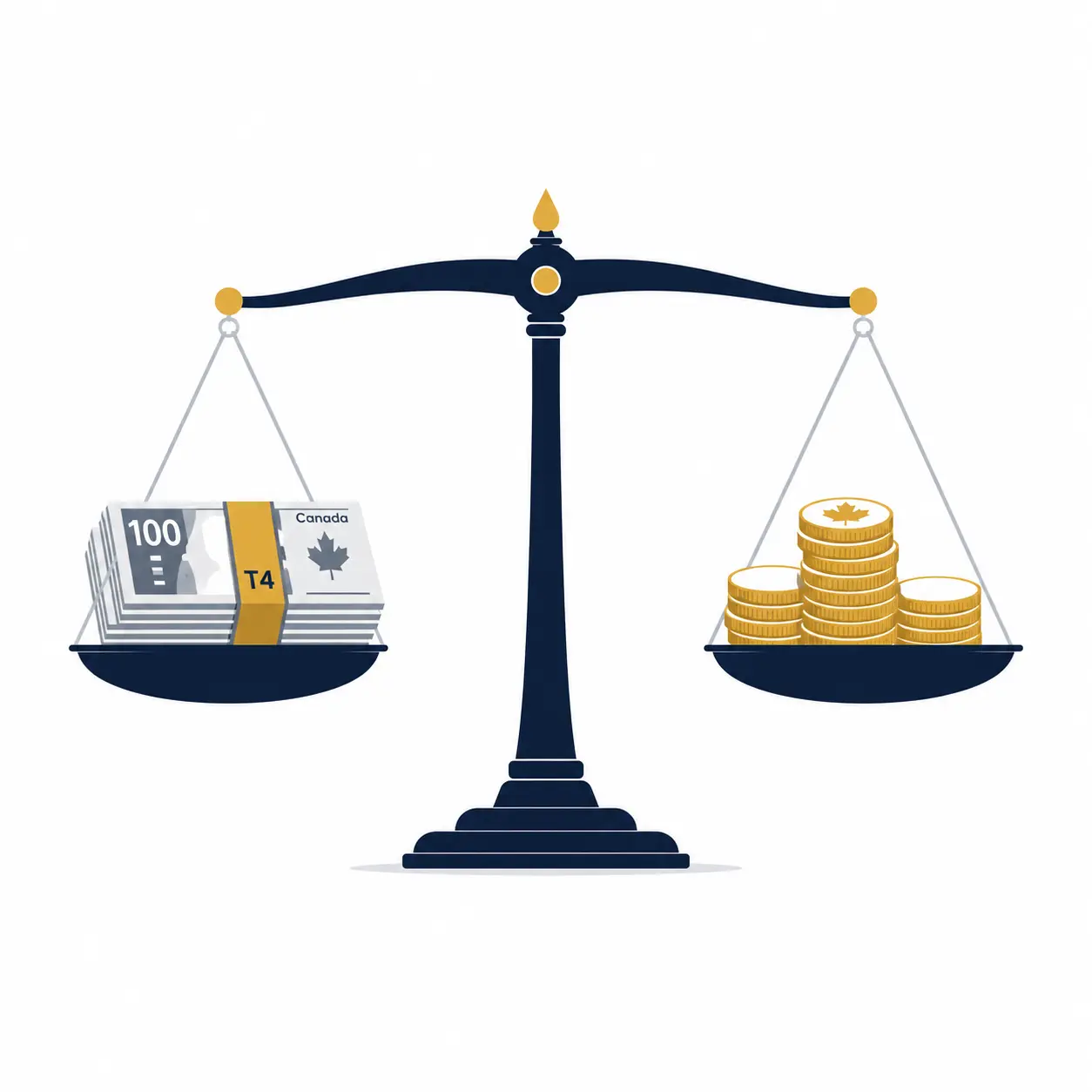
Every dollar flows out as a T4 salary. Corporation deducts the wage and matches CPP. You build RRSP room and full CPP credits.
Salary + dividend mix
You set the salary share with the slider. The remainder of the corporate income leaves the company as a non-eligible dividend after corp tax.
All dividend
Salary is zero. The corporation pays small business tax, then distributes the after-tax balance as a non-eligible dividend. No CPP, no RRSP room.
This contribution is above the room generated by this scenario (18% of salary, capped at $33,810). Without carry-forward room from prior years, the excess is not deductible.
This contribution is above the room generated by this scenario (18% of salary, capped at $33,810). Without carry-forward room from prior years, the excess is not deductible.
This contribution is above the room generated by this scenario (18% of salary, capped at $33,810). Without carry-forward room from prior years, the excess is not deductible.
How to read these numbers
Take-home is one signal among several. The notes below explain what the calculator hides and what it does not model.
Net only tells half the story
CPP contributions are not "lost" money. They build retirement income (and the employer half is deductible to the corporation). The same dollar of "tax" feels different depending on what it is buying.
Dividends do not contribute to CPP
Dividend income is not pensionable, so it does not buy any future CPP retirement benefit. An owner paid only in dividends will reach 65 with no CPP entitlement built from that income, regardless of how high the dividend was.
RRSP room only comes from earned income
Salary creates RRSP room (18% of the prior year up to the annual maximum). Dividends do not. If you plan to invest inside an RRSP, all-dividend leaves money on the table.
The right answer is rarely a corner
Pure all-salary or all-dividend can win on the spreadsheet, but most owners land on a mix that funds CPP, leaves room for retained earnings, and keeps the personal bracket from spiking.
This is a basic comparison
The calculator assumes 100% of the corporate income flows out to the owner in the same year (no retained earnings, no investment portfolio inside the corp). Real planning weighs deferral, RDTOH, integration math, and family income splitting that this tool does not model.
A few important caveats
This calculator uses 2026 federal and provincial tax brackets (federal lowest rate dropped to 14%), the federal basic personal amount and provincial basic personal amounts applied at each lowest rate, the non-eligible dividend tax credit federally and provincially, the CPP base-portion contribution credit (4.95%) federally and provincially with the enhanced 1% and CPP2 portions deducted from taxable income, and the Canada Employment Amount ($1,501) federally when there is salary income. Corporate tax uses the federal small business deduction (9% up to $500,000, 15% above), the provincial small business rate up to the province business limit ($500,000 default; $600,000 for Saskatchewan and PEI; $700,000 for Nova Scotia) and the provincial general rate above that limit, with 2026 CPP rates including CPP2. It includes the Ontario Health Premium (OHIP) on top of Ontario personal tax. Quebec is excluded from the comparison (QPP, QPIP, and parallel Quebec filing need a separate model). It does not model: Ontario or other provincial surtaxes, EI (owner-managers are usually exempt), eligible dividends from general-rate income, RDTOH refunds, or US/non-resident considerations. The numbers here are for orientation only and should not be relied on for filings.
Ready to plan, not just file?
Book a Discovery Session. No cost, no commitment.
Book a Discovery Session