Most Canadian residents file a T1 personal income tax return annually. For most people, it's straightforward, employment income, RRSP contributions, a few deductions. For incorporated business owners, newcomers to Canada, or anyone with international income, it can get more complex.
Notice
We're not accepting new personal tax clients right now
We have temporarily paused onboarding of new personal (T1) tax return clients. This page stays available for reference, and we plan to reopen personal tax intake later.
Services
Personal Tax
Personal returns for complex situations: foreign income and assets, T1135, newcomers to Canada. Filed correctly the first time, with planning for the next year baked in.
What it is
What is personal tax filing?
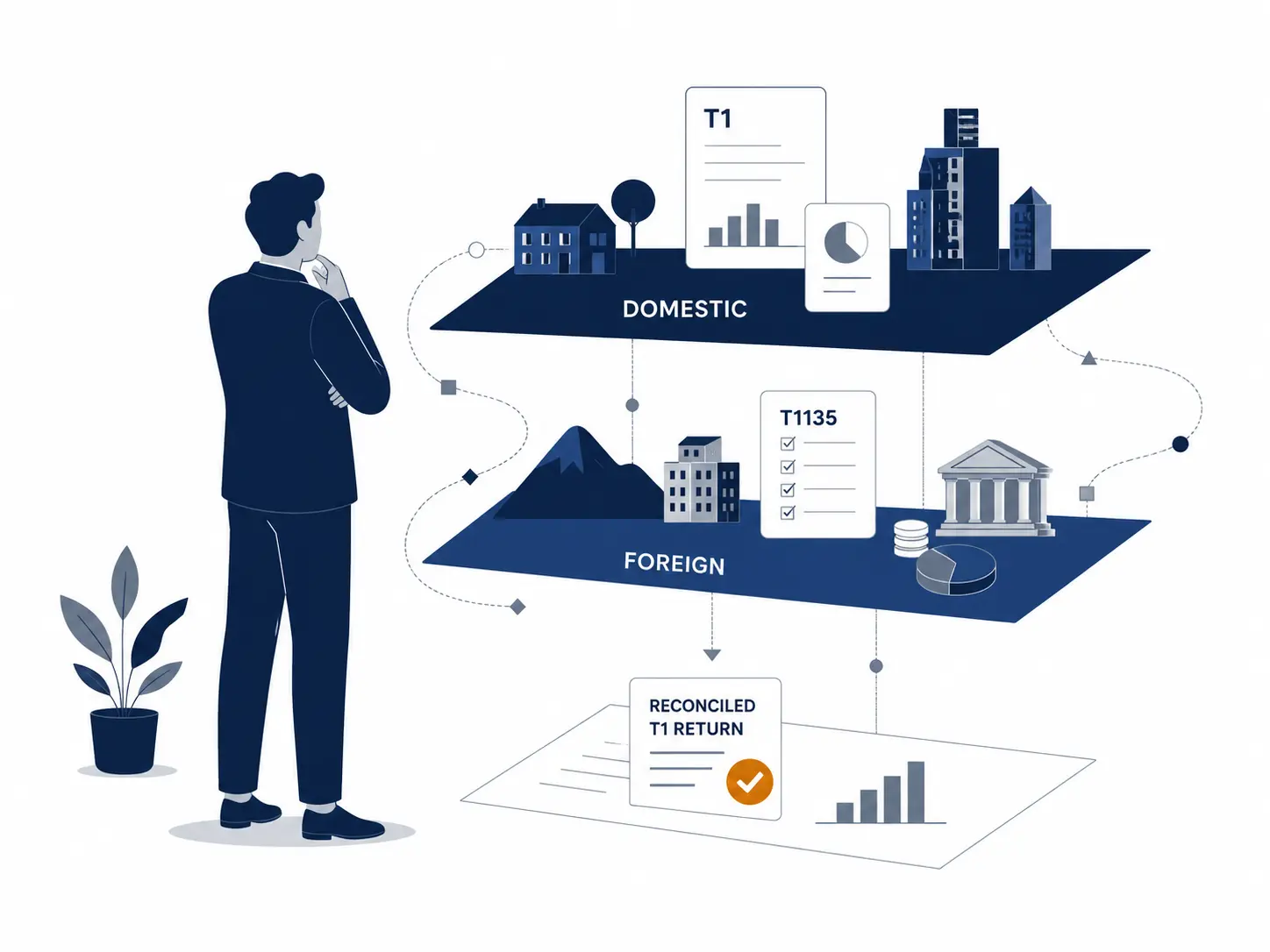
Foreign property over CAD 100,000.00 (T1135). Income or other amounts received from outside Canada that need to be reported here but may also be taxed in another country. Newcomers in their first or second year of residency, where the rules differ from established residents. Owners with both T4 and T5 income from their own corporation.
These situations have rules that don't appear in basic tax software. Done wrong, they can create CRA exposure. Done right, they optimize your tax position across jurisdictions and keep you compliant.
What we do
Personal Tax services
Personal tax filing goes well beyond a basic T1 once foreign assets, residency changes, or corporate income enter the picture. Here is the scope of what we handle for complex personal returns.
-
T1 personal income tax return
Prepared and filed with the CRA, with all relevant schedules and forms included.
-
T1135 foreign property reporting
When you hold specified foreign property with an aggregate cost over CAD 100,000.00, T1135 is required. Eligible assets include foreign bank accounts, shares of non-Canadian corporations (even when held in a Canadian brokerage), real estate outside Canada other than personal-use property, debts owed by non-residents, and interests in foreign trusts. Excluded are personal-use real estate, assets held in registered accounts (RRSP, TFSA), and property used in an active business. Determining what counts, how to value it, and which cost amount applies has its own rules. We prepare and file it correctly.
-
Foreign income coordination
Income from outside Canada reported on the T1, with foreign tax credits and exemptions applied where treaties allow.
-
Departure and arrival year filings
The year you arrive in Canada or leave Canada has different rules from a regular tax year. Partial-year residency, deemed disposition of assets, and treaty considerations all need to be handled correctly, often alongside tax planning when the move is planned in advance.
-
Newcomer guidance
First-year and second-year filings for new Canadian residents, where partial-year rules and deemed disposition matter.
Who
Who this is for
Our personal tax work focuses on situations that do not fit basic tax software. If any of the profiles below describe you, we can help.
Owners of incorporated businesses
Filed alongside your T2, with salary/dividend mix coordinated with tax planning.
Canadian tax residents with foreign assets
Property, accounts, or investments outside Canada that may trigger T1135 reporting, regardless of citizenship.
Newcomers to Canada
The first years of residency have unique rules. Setting up correctly from the start is easier than fixing things later, especially with income or property in the country of origin. We recommend a paid consultation before arrival: organizing assets, closing tax obligations, and choosing the right residency date avoids costly corrections later.
People leaving Canada
Departure triggers departure tax (a deemed disposition of certain assets as if sold on the day you leave) and the exit year has its own rules. Structuring before the departure date avoids inflated tax and disputes later.
People selling significant assets
Real estate, stocks, crypto, business interests. Capital gain inclusion, principal residence exemption, timing across tax years, FX movement between cost and sale, and the date of entry into Canada (which sets the adjusted cost base of pre-residency assets) all change the final outcome.
Recipients of stock options or RSUs
ESO, RSU, and ESPP plans have tax rules that vary by type, vesting, exercise, and sale. Reporting them wrong can double the tax owed or forfeit the 50% deduction.
People selling a business
Share vs. asset sale, eligibility for the Lifetime Capital Gains Exemption (LCGE), and coordination with the final T2. Decisions made before closing define the tax owed, which is why tax planning ahead of time usually pays for itself many times over.
Self-employed individuals
Service income earned without an incorporated business goes on T2125, with deductible expenses, full CPP (employer and employee portions), and instalment management. Past the $30,000.00 threshold over 4 quarters, GST/HST is in scope too. We file it right and set you up to avoid an April surprise.
Non-residents with Canadian income
Non-residents who receive Canadian rental, dividend, or other income may need a specific filing (Section 216, Section 217, or non-resident T1). We handle the filing and coordinate with the treaty in your country of residence.
People navigating the Brazil-Canada tax treaty
The Brazil-Canada tax treaty defines which country taxes each type of income, applicable foreign tax credits, and specific exemptions. Applying it wrong overpays tax or creates conflict between the two tax authorities. Using it well lowers total tax owed and keeps you compliant on both sides.
People bringing money in from abroad
Large transfers from outside Canada are not taxed in themselves, but the source matters. The CRA may request documentation on pre-residency assets, inheritance, asset sales, or already-taxed income. We document the source correctly to avoid reassessment and follow-up questions.
People taxed twice on the same income
Income already taxed in the country of origin can be charged again in Canada if nothing is done. Foreign tax credits, treaty exemptions, and reporting timing prevent double taxation. Each case depends on the income type, country of origin, and applicable treaty.
What our clients say
"Excellent service and great professionalism in preparing my tax return. Organized process with great attention to detail. Recommend."
A.M.
Toronto, ON
"Saulo took great care of me. He filed my taxes and my Sole Proprietor company taxes. Very patient and clear. Highly recommend!"
Fernanda F.
Vancouver, BC
"I had an issue with my tax return because I didn't know what I was doing, and Saulo and the team helped me solve it with great clarity and professionalism. Thank you very much."
Felipe S.
Halifax, NS
"Impeccable service, fast and efficient!"
Maria Teresa A.
Vancouver, BC
"I highly recommend the service. Saulo was always available to answer any questions, providing fast service. Thank you."
William B.
Ottawa, ON
"Very attentive team with technical knowledge. They organized a complex situation in my tax return and identified opportunities during the process. Unlike a previous experience, they were very patient in explaining everything I didn't understand."
R.A.
Calgary, AB
"Saulo is a top-notch accountant, he was keen to provide the best advice and tax filing services, masterfully guiding us through the most trustworthy way to address my scenario. I'll definitely hire his services again for the next tax season. Thanks a lot!"
Júlio P.
Winnipeg, MB