Free calculator · 2026 rates
True Payroll Cost Calculator for Canadian Employers (2026)
How much does an employee really cost your Canadian corporation in 2026? Salary is only the visible part of payroll. This calculator adds the full employer burden, CPP and CPP2, EI, vacation pay, WCB or WSIB, Employer Health Tax, extended health benefits, and RRSP match, so you see the true annual cost of a hire across every Canadian province and territory (Quebec excluded), with current 2026 federal and provincial rates.
At this stage, the actual WCB classification, EHT exposure, salary versus dividend mix, RRSP structure, and benefits design start to matter as much as the math itself. Businesses at this size typically need payroll, T2 corporate tax, bookkeeping, and tax planning handled by the same team so nothing slips between the cracks. A 30-minute discovery session models your exact situation against 2026 federal and provincial rates and shows you which levers are worth pulling first.
- Payroll set up with the right WCB classification and EHT exposure for your province
- Bookkeeping kept clean alongside payroll, so corporate tax filing is straightforward
- T2 corporate tax and tax planning aligned with your salary versus dividend mix
How the math works
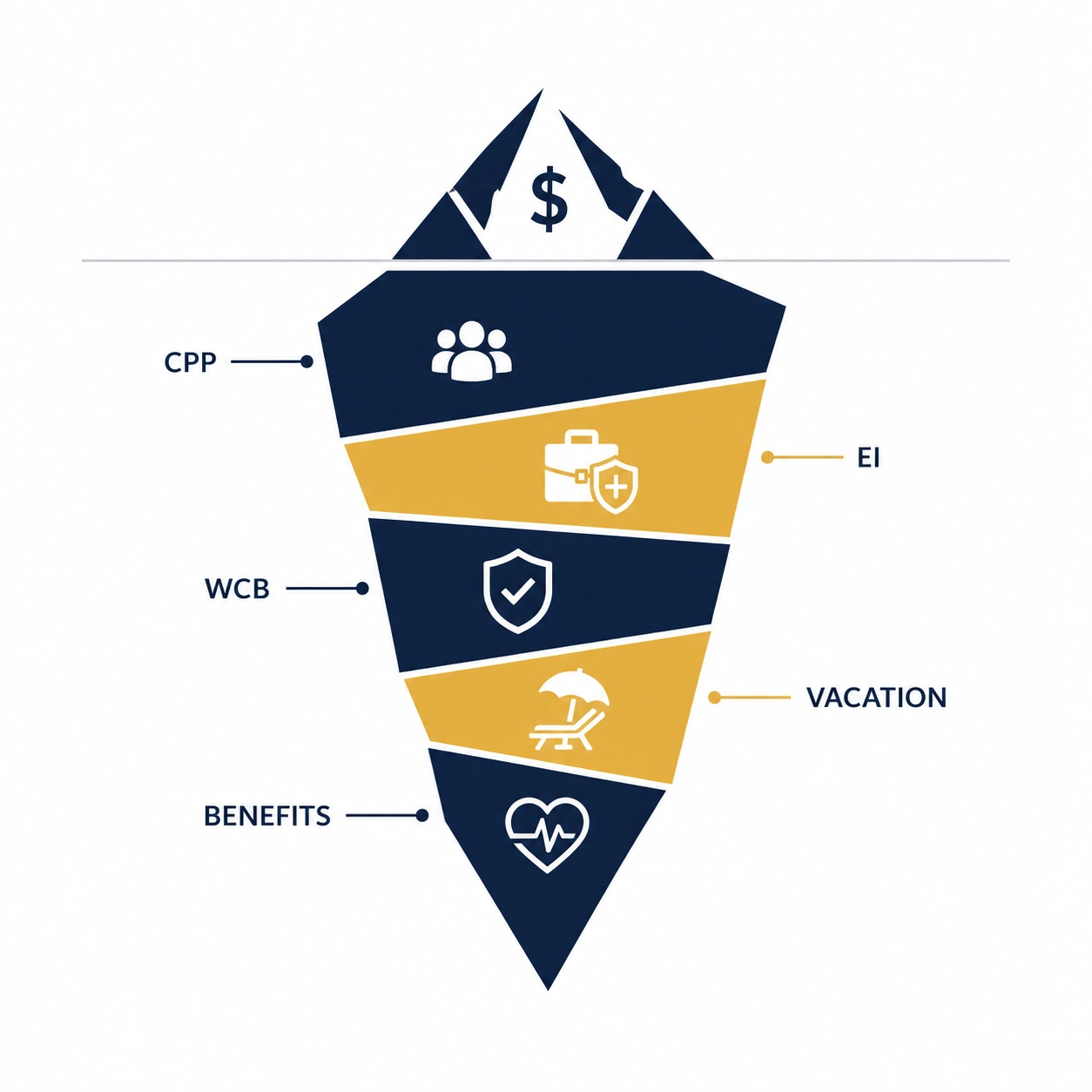
The salary is the visible part of the iceberg. Five layers sit below the waterline.
CPP and EI
For 2026, federal CPP1 employer rate is 5.95% on earnings between the basic exemption ($3,500) and the YMPE ($74,600), capped at $4,230.45 per employee. CPP2 adds 4% on the slice between YMPE and the YAMPE ($85,000), capped at $416. EI employer rate is 2.282% on earnings up to the MIE ($68,900), capped at $1,572.30. Quebec is excluded from this calculator (QPP, QPIP, and FSS need a separate model).
Vacation pay
The Canada Labour Code and most provincial employment standards require vacation pay of at least 4% of gross wages. Some industries and CBAs require 6% or more. If the salary already absorbs paid time off, set the vacation rate to 0%.
WCB / WSIB
Provincial workers’ compensation premium. The rate shown is the provincial average; your actual rate depends on your industry classification (a roofer pays multiples of what an office worker pays). A few classes of workers are exempt from mandatory coverage.
Employer Health Tax
Ontario charges 1.95% on Ontario payroll above $1M (most small employers are exempt). BC charges 5.85% on the slice between $1M and $1.5M, then 1.95% above. Other provinces either don’t charge an EHT or set the threshold so high it rarely applies.
Vacation, benefits, RRSP
Extended health, dental, life, and disability benefits typically run $1,500 to $4,500 per employee per year for SMBs. RRSP matches are optional but, when offered, are usually 3% to 5% of salary, deductible to the corporation.
A few important caveats
Estimate for planning purposes only, not payroll or tax advice. Uses 2026 federal CPP, EI, and provincial WCB averages. Your WCB rate varies significantly by industry classification, your actual rate could be higher or lower. Quebec is excluded from the calculator (QPP, QPIP, FSS, and the parallel Quebec filing need a separate model). Want a precise number for your specific province, industry classification, and benefit package? Book a Discovery Session and we will model the cash impact on your retained earnings.

Ready to plan, not just file?
Book a Discovery Session. No cost, no commitment.
Book a Discovery Session